Know the Types of Loans.
As a future homeowner, it is equally important to research the types of mortgages as it is the community you wish to live in. The type of mortgage you will need depends on your needs and will help determine how much you can afford to spend on a home.
There are many kinds of loans to pick from, and it’s very important to fully understand the positives and negatives of each kind before you choose one. Each type of mortgage loan has a unique set of requirements that will affect your interest rate, terms, and lender. Picking the right kind of mortgage for your own personal needs and situation can lower your down payment and lower the overall interest payment over the life of the loan.
Do you need help finding a lender in the area? Contact us today!
Requirements to Obtain a Mortgage
The following factors can influence which type of mortgage you may qualify for.
- Down Payment: The amount of your down payment you put down on your home can impact the mortgage rate given. You will typically need between 3-10% depending on the type of loan you qualify for.
- Monthly Mortgage Payment: Lenders will need to look at your income, pay stubs, and assets to determine the total loan amount you will be able to afford.
- Credit score: Your credit score will help determine what your interest rate will be. As low as 500 can qualify for a home loan.
Loan Types
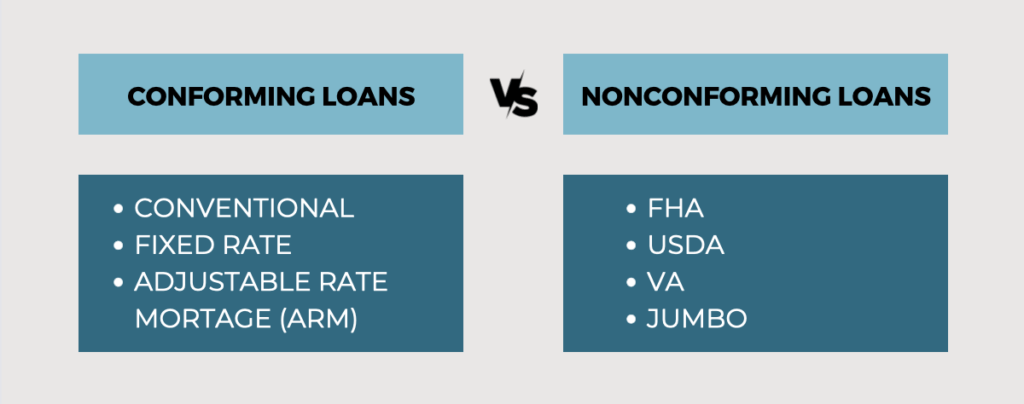
Conforming Loans
Conforming Loans require a strict set of criteria to qualify, meaning it’s harder to obtain, but conforming loans are less risky, meaning a lower interest rate.
A conventional loan is a type of mortgage that isn’t backed by a government agency. Unlike FHA, VA, and USDA loans, conventional loans are widespread. You can be approved for a typical conventional loan with a credit score as low as 620, though some lenders prefer a score of 660 or higher.
These loans come in various sizes, and down payment requirements can be as low as 3%. Some lenders even offer special programs allowing up to 100% financing. However, if your down payment is less than 20%, you usually have to pay for private mortgage insurance.
Conforming conventional loans can go up to $647,200 for single-family homes in 2022 (or $970,800 in high-cost areas). If you need a larger loan, you’d have to consider a jumbo loan. You can choose between a fixed-rate or adjustable-rate loan, and your interest rate depends on your credit score and overall credit history. The better your credit, the lower your interest payments will be over the loan’s lifespan.
- Jumbo Loan: A jumbo loan is any typical mortgage surpassing the yearly conforming loan limits established by the Federal Housing Finance Agency (FHFA). For the year 2024, the maximum limit for a conforming loan is $766,550 in the majority of counties. These typically require a higher down payment. While some lenders may agree to a 10% down payment for jumbo loans, the prevailing requirement from most lenders is a minimum down payment of 20%.
- Fixed Rate Loan: A fixed interest rate loan is a type of loan where the interest rate remains constant throughout the specified fixed-rate period, providing the borrower with the ability to forecast their upcoming payments reliably.
- Adjustable Rate Loan: An adjustable-rate mortgage (ARM), or variable-rate mortgage, features an interest rate that adjusts based on market conditions over time. With a lower initial interest rate compared to fixed-rate mortgages, ARMs offer an attractive option for those seeking initial cost savings. However, payments can fluctuate as interest rates change, potentially becoming more affordable if rates drop or more expensive if rates rise.
Non-Conforming Loans
Non-Conforming loans have less strict guidelines. Meaning if your credit is not great, you can still qualify. These types of loans are typically insured by the government.
- Federal Housing Administration (FHA): An FHA loan, backed by the government, provides more flexible financial criteria for homebuyers, permitting qualification even with existing debt or a lower credit score. Borrowers can secure a portion of a home’s value based on their credit score, with those surpassing 580 eligible for financing up to 96.5%, while scores between 500 and 579 necessitate a 10% down payment. To meet requirements, the home must undergo appraisal by an FHA-approved appraiser, serve as the primary residence (it cannot be an investment property or second home), be occupied within 60 days of closing, and pass an inspection confirming adherence to minimum property standards.
Veterans Affairs (VA): A VA loan is a mortgage guaranteed by the Department of Veterans Affairs in the United States, catering to American veterans, current U.S. military members, reservists, and certain surviving spouses (as long as they do not remarry). This program provides distinct advantages compared to traditional mortgages.
Among the notable benefits for veterans, the VA home loan stands out. In contrast to conventional loans, VA home loans usually do not demand a down payment, thereby enhancing the accessibility of homeownership for veterans.
The U.S. Department of Agriculture (USDA): A USDA home loan is a mortgage that doesn’t require a down payment and is available for homebuyers in qualifying towns and rural areas. These loans are backed by the USDA Rural Development Guaranteed Housing Loan Program, a division of the U.S. Department of Agriculture. While most USDA loans are provided through partner lenders, the department can also directly grant them to eligible borrowers with incomes below a specified limit.
Apart from the absence of down payment requirements, USDA home loans frequently offer lower interest rates compared to conventional mortgages. This is due to the government assuming the risks associated with lending, making homeownership more accessible in rural and eligible areas.
Once You Get Your Loan, Your Monthly Payment Has 4 Parts:
Principal: Paying back the amount you borrowed
Interest: Fee to the bank for lending you the amount you borrowed
Taxes: Money to the government for services for the area you live in
Insurance: Protection in case an accident happens at your home
PMI: Penalty from the bank if you don’t put 20% down